Master Continuity and Handoff: Network Configuration for Seamless Apple Device Integration

Why Your Network Setup Matters for Apple Device Continuity
Your network is the invisible highway connecting all your Apple devices. Without proper configuration, even the most powerful iPhone, iPad, and Mac sit isolated from one another, unable to share the seamless experience we've engineered into our ecosystem. The difference between a chaotic setup and an optimized one is striking: one leaves you fumbling between devices, the other lets you start writing an email on your iPhone and finish it on your Mac without missing a beat.
We've built continuity features that demand a foundation of rock-solid wireless connectivity. When your Wi-Fi network isn't properly tuned, handoff lags, AirPlay stutters, and that magical cross-device experience crumbles. The network configuration you choose directly impacts whether our advanced features work flawlessly or frustrate you into manual workarounds.
Think of it this way: you wouldn't pour premium fuel into a car with a clogged fuel filter. Our devices deserve equally serious network infrastructure. Getting this right transforms how you work, create, and enjoy content across your entire collection of Apple products.
Action step: Audit your current router's specifications. Write down its model, Wi-Fi standard (Wi-Fi 5 or Wi-Fi 6), and when you last updated its firmware. You'll need this information to evaluate whether an upgrade makes sense.
Understanding Continuity, Handoff, and AirPlay in Our Ecosystem
These three features form the backbone of what makes owning multiple Apple devices genuinely powerful. Continuity lets your devices know about each other, maintaining context and awareness across your entire ecosystem. Handoff takes that one step further, letting you literally pass tasks between devices without interruption. AirPlay streams audio, video, and screen content to speakers, displays, and Apple TV devices with precision.
Continuity runs constantly in the background, using Bluetooth and Wi-Fi to keep your devices synchronized. It powers features like Universal Clipboard (copy something on iPhone, paste it on Mac), Instant Hotspot, and Sidecar (using iPad as a secondary display). None of these work if your devices can't reliably communicate over your network.
Handoff is the showstopper. Start composing in Mail on your iPhone, and your Mac's Mail app shows an icon prompting you to pick up exactly where you left off, complete cursor position and all. This requires your devices to be on the same Wi-Fi network and logged into the same iCloud account, but the technical coordination happening behind the scenes is remarkable.
AirPlay extends this philosophy outward. Stream music from your iPhone to speakers in different rooms, mirror your Mac to an Apple TV 4K for presentations, or send video playback to a compatible display. Each scenario demands different network characteristics to perform flawlessly.
Action step: Verify all your devices use the same iCloud account. Sign into Settings (iPhone/iPad) or System Settings (Mac), navigate to your account section, and confirm you're signed in. Handoff requires this to work.
Essential Wi-Fi Requirements for Seamless Device Handoff
Not all Wi-Fi networks are created equal. We recommend Wi-Fi 6 (802.11ax) as the gold standard for modern Apple device integration. Wi-Fi 6 delivers higher throughput, reduced latency, and better performance when multiple devices connect simultaneously, all of which matter when you're juggling iPhone, iPad, Mac, and Apple Watch on the same network.
If you're still running Wi-Fi 5 (802.11ac), handoff and continuity will work, but you'll notice occasional lag when transitioning between devices. Wi-Fi 4 or older creates serious friction and frequently drops the connection between devices entirely, breaking handoff completely.
Your network also needs consistent 2.4 GHz and 5 GHz bands. Most modern routers broadcast both simultaneously. Devices use 5 GHz for speed when they're close to the router and automatically drop to 2.4 GHz for better range when needed. If your router broadcasts only one band, you're limiting flexibility and creating dead zones where continuity fails.
Signal strength matters more than you'd think. Aim for Wi-Fi signal at least -60 dB throughout your home (stronger is better, but anything better than -70 dB works acceptably). Weak signals cause devices to disconnect and reconnect, breaking the sustained connection that handoff requires.
Action step: Use the Wireless Diagnostics tool on your Mac. Hold Option, click the Wi-Fi icon in the menu bar, select "Wireless Diagnostics," and run the scan. This shows your signal strength in real numbers and reveals interference from neighboring networks.
Optimizing Your Mesh Network for Apple Devices
Mesh systems (like those from Eero, Ubiquiti, or built-in through your primary router) offer superior coverage compared to single-unit routers, especially in larger homes. A mesh network uses multiple nodes strategically placed throughout your space to maintain strong, consistent coverage everywhere your Apple devices roam.
The critical detail: ensure your mesh system supports Band Steering and Roaming Assistance. Band steering automatically guides devices to the optimal Wi-Fi band (2.4 GHz or 5 GHz) based on their distance and capability. Roaming assistance helps devices smoothly transition between mesh nodes without dropping connection, which is essential for handoff to work when you move from room to room.
Disable any "fast roaming" or "802.11r" settings unless they're specifically tested with Apple devices. Some aggressive roaming features can actually destabilize the connection between your devices and your Mac, which causes handoff to fail intermittently.
Place mesh nodes strategically. Position your primary router centrally and node placement within 30-50 feet of each other, depending on your home's construction. Walls and metal objects weaken signals, so avoid closets, basements, or metal furniture as node locations.
Action step: Log into your mesh router's admin panel and verify Band Steering is enabled. Search for "Band Steering," "Smart Connect," or similar naming depending on your router's brand, then toggle it on. Save your settings and give devices 5 minutes to reconnect.
Router Settings That Enable True Device Continuity
Deep inside your router's settings lie configuration options that directly impact whether handoff works reliably. Start with Multicast DNS (mDNS), which allows your devices to discover each other on the network. Most routers enable this by default, but confirm it's active by checking your router's admin panel under network settings.
Multicast must remain enabled. It's sometimes hidden under "Multicast enhancement," "IGMP Snooping," or similar terminology. When disabled, your devices can't announce their presence to one another, and handoff fails silently.
UPnP (Universal Plug and Play) should be enabled as well. This protocol lets devices automatically configure network settings without requiring manual intervention. It's safe when combined with a properly configured firewall, and we strongly recommend keeping it active for seamless continuity.
Disable any "access control" or "MAC filtering" features that might block specific devices. These security measures can accidentally prevent your devices from communicating with each other. Your firewall provides sufficient protection without these additional restrictions.
Channel width settings matter too. Set your 5 GHz band to use 80 MHz channel width if available (this is standard with Wi-Fi 5 and Wi-Fi 6). For 2.4 GHz, use 20 MHz channel width to minimize interference with neighboring networks. Wider channels provide faster speeds but only when devices and routers support them consistently.
Action step: Access your router's settings page (typically 192.168.1.1 or printed on the router label). Find the Wireless or Advanced settings section and locate "Channel Width." Set 5 GHz to 80 MHz and 2.4 GHz to 20 MHz, then save changes.
Configuring AirPlay Across Your Home Network
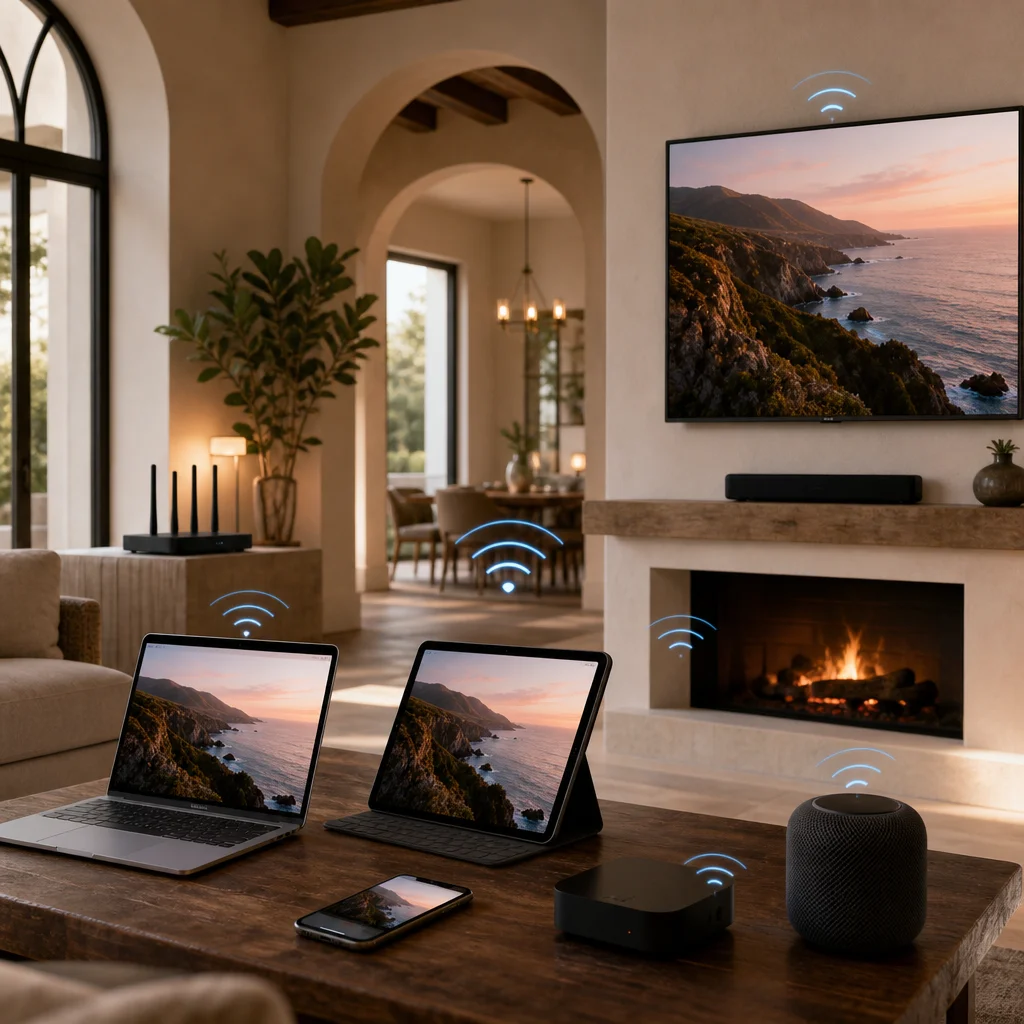
AirPlay requires your devices to reside on the same Wi-Fi network, but there's more nuance to successful streaming than many people realize. Your speaker, Apple TV, or display must be powered on and connected to Wi-Fi before AirPlay will detect it. Additionally, all devices must be signed into the same iCloud account.
Enable AirPlay on your target devices by going into their settings. For Apple TV, navigate to Settings > Apps > AirPlay and HomeKit, then verify AirPlay is turned on. For HomePod or other AirPlay speakers, they'll show up automatically once they detect your primary device on the network.
Create an AirPlay-friendly environment by grouping devices in the Home app. Add speakers to rooms and create zones. This lets you stream to "Kitchen" speakers or "Living Room" display without manually selecting individual devices each time. It's a small organizational step that dramatically improves usability.
If AirPlay devices appear inconsistently, it's usually a network discovery issue. Restart your devices in this order: router first (30 seconds off), then your primary streaming device (iPhone or Mac), then your AirPlay target device (speaker or Apple TV). This resets the discovery process.
Action step: Open the Home app on your iPhone, tap the house icon, then tap "Home Settings." Add each AirPlay device to a room and verify it shows "Connected." Test AirPlay from your iPhone by opening Control Center, swiping to the Now Playing card, and selecting an AirPlay device.
Advanced Network Troubleshooting for Connectivity Issues
When handoff fails or AirPlay drops, the issue usually traces back to one of three culprits: devices losing Wi-Fi connection, devices unable to discover each other, or bandwidth saturation on your network.
Start with the nuclear option: restart everything. Power off your router completely (wait 30 seconds), then restart each Apple device. Many connection issues resolve through this simple reset. If problems persist, move to more targeted solutions.
Check for interference. Move your router away from microwaves, cordless phones, and baby monitors, which broadcast on the 2.4 GHz band and disrupt Wi-Fi. Bluetooth devices don't typically interfere with Wi-Fi, contrary to popular belief.
Verify your devices are on the 5 GHz band when possible. Open Settings on iPhone or iPad, go to Wi-Fi, select your network, and look for a band indicator if your router displays it. Devices automatically choose the optimal band, but older devices sometimes get stuck on 2.4 GHz.
If one specific device (say, an older iPad) won't handoff, it might not support Wi-Fi 6 or certain continuity features. Check Apple's technical specifications for your device's Wi-Fi standard and OS version requirements. Consider updating to the latest iOS, iPadOS, or macOS version, which often resolves compatibility issues.
Action step: Run the Console app on your Mac (open Spotlight, search "Console"). Filter for "Handoff" or "Continuity" to see real-time logs of connection attempts. If you see repeated error messages, take a screenshot and reference Apple's support documentation for that specific error code.
Security Best Practices for Your Connected Apple Network
A properly secured network is essential when your devices constantly communicate and share data. Enable WPA3 encryption on your router if it supports it, falling back to WPA2 if WPA3 isn't available. Never use WEP or open networks for devices handling sensitive personal information.
Create a strong router password (20+ characters, mixing upper and lowercase letters with numbers and symbols). This prevents unauthorized access that could compromise your network's integrity or intercept data flowing between your devices.
Enable your router's firewall, but configure it to permit multicast traffic (required for device discovery). Most modern firewalls have granular settings; enable the firewall while explicitly allowing mDNS packets.

Separate IoT devices into a guest network if your router supports network segmentation. This doesn't apply to your Apple devices, but it prevents poorly secured smart home gadgets from potentially affecting your device continuity performance.
Disable Universal Plug and Play (UPnP) if you don't actively use it. While we recommended enabling it for continuity features, if you've manually configured your network, you can disable it to reduce the attack surface.
Action step: Change your router's default password immediately. Log in, navigate to Administration or Security settings, find "Router Password," and create a strong, unique password. Write it down in a secure location (password manager) and save your changes.
Performance Tuning for Multi-Device Streaming
When you're streaming 4K video to Apple TV while simultaneously using AirPlay for audio in another room and video calling on your Mac, network bandwidth becomes your limiting factor. Most modern routers handle this well, but optimization ensures smooth performance.
Prioritize your Apple devices using Quality of Service (QoS) settings. Access your router's admin panel, find QoS settings, and assign high priority to your primary devices (iPhone, Mac, Apple TV). This ensures they get preferential bandwidth when multiple devices compete for resources.
Check your internet connection's upstream bandwidth. Handoff and continuity primarily use local network bandwidth, not internet bandwidth, but streaming video to Apple TV often relies on internet connectivity. Run a speed test at speedtest.net and verify you have at least 25 Mbps for stable 4K video streaming.
Reduce 2.4 GHz congestion by manually selecting a Wi-Fi channel on your router. Use Wi-Fi analyzer apps to see which channels nearby networks occupy, then choose a channel with minimal overlap. Channels 1, 6, and 11 are standard non-overlapping options in the US.
Action step: Download a Wi-Fi analyzer app (search "Wi-Fi Analyzer" on iPhone App Store) and run a scan. Note which channels your neighbors use, then log into your router and manually select the least congested channel for your 2.4 GHz band.
Getting the Most From Your Apple Device Integration
Your network investment pays dividends across your entire ecosystem. With proper configuration, you're not just enabling technical features, you're unlocking a genuinely integrated experience that saves time and frustration every single day.
Start by ensuring your most critical devices work flawlessly. Get handoff working between iPhone and Mac first, then expand to iPad and other devices. Test each feature individually before troubleshooting complex multi-device scenarios.
Consider using our Online Personal Setup service if network configuration feels overwhelming. Our specialists can walk you through optimal settings for your specific home setup and devices.
Document your router settings once you've got everything working. Write down your channel selections, QoS priorities, and any custom configurations. This becomes invaluable when troubleshooting future issues or if you need to reset your router.
The payoff is extraordinary. With a properly configured network, your devices become extensions of one another, your creativity flows seamlessly across screens, and technology recedes into the background where it belongs. That's the Apple experience we've worked relentlessly to deliver.
Final action step: Schedule a quarterly network audit. Check for firmware updates to your router, verify your settings remain optimal, and ensure all devices maintain strong signal strength. A few minutes of preventative maintenance prevents months of frustration later.