Master Continuity and Handoff: Complete AirPlay Troubleshooting for Apple Users

When Seamless Integration Breaks: Understanding Your Connectivity Challenge
There's nothing quite like that frustrating moment when you're ready to hand off a task from your iPhone to your Mac, and nothing happens. You tap, you swipe, you wait. Nothing. The seamless experience we've engineered into our ecosystem suddenly feels anything but seamless.
We get it. You bought into the Apple experience precisely because these moments shouldn't exist. Your devices are supposed to work together like a well-orchestrated symphony, not like instruments playing different songs. When Continuity falters, Handoff freezes, or AirPlay won't connect, it disrupts your entire workflow.
The good news? Most connectivity issues stem from a handful of predictable causes, and we're going to walk you through solving them. Whether your iPad won't continue where your iPhone left off or your Mac refuses to stream audio through your HomePod, the fix usually lies in one of several specific areas we'll explore.
How Apple's Ecosystem Connectivity Works: The Foundation You Need
Our ecosystem operates on several interconnected systems working in perfect harmony. Understanding how they function gives you the insight you need to troubleshoot effectively.
Continuity is the foundation. This feature allows you to start something on one device and finish it on another. You draft an email on your iPhone during your commute, and when you sit down at your Mac, that draft is right there waiting. It's not magic, it's precision engineering using Bluetooth proximity detection and your iCloud account to sync activity.
Handoff takes Continuity further by allowing you to literally pass an active task from one device to another. Your browser session, your document, your video call can transition between devices almost instantaneously. This requires all your devices to be signed into the same iCloud account and connected to the same Wi-Fi network.
AirPlay powers wireless audio and video streaming across your devices. When you want to send music from your iPhone to your speakers or extend your Mac's display to an Apple TV, AirPlay handles the heavy lifting. It's built on a foundation of mutual authentication, automatic device discovery, and low-latency streaming protocols.
All three systems depend on three critical factors: proximity via Bluetooth, network connectivity, and device authentication through your Apple ID.
Diagnosing Continuity Failures: Our Step-by-Step Approach
Before you start changing settings, identify exactly what's broken. This narrows your troubleshooting path dramatically.
Start here: Can you see your other devices at all? On your iPhone or Mac, look for your other device's name appearing as an option. If it doesn't show up, the problem is almost certainly Bluetooth proximity or network connectivity. If it shows up but doesn't respond, you're looking at an authentication or software issue.
Next, verify your network. Are all devices connected to the same Wi-Fi network? Sounds obvious, but many users don't realize their devices have connected to different networks, which breaks Continuity completely. Check your Wi-Fi settings on each device.
Then check your iCloud status. All devices must be signed into the same iCloud account. Open Settings (or System Settings on Mac), go to your name/account, and confirm you're logged in. If accounts differ between devices, nothing will sync.
Take action: Grab one device and systematically verify these three items across each of your Apple devices. Document what you find. This information becomes your diagnostic roadmap.
Fixing Handoff Problems: Getting Your Workflow Back on Track
Handoff-specific issues typically fall into two categories: your devices can't see each other, or they see each other but won't transfer tasks.
If devices aren't visible, enable Handoff explicitly. On Mac, go to System Settings > General > AirPlay and Handoff, then check "Allow Handoff between this Mac and your iCloud devices." On iPhone and iPad, open Settings > General > AirPlay and Handoff and toggle it on.
If devices are visible but Handoff fails when you try it, restart both devices. This clears temporary connection states that sometimes prevent the handoff from completing. Shut down completely, wait 30 seconds, then power back on.
Next, toggle Bluetooth off and on. Go to Settings, toggle Bluetooth off, wait five seconds, then toggle it back on. This refreshes your Bluetooth connection stack without requiring a full restart.
If you're still experiencing issues, sign out of iCloud completely on one device, then sign back in. This forces your device to re-authenticate with Apple's servers and resync your account information. On Mac, go to System Settings > [Your Name] > Sign Out. On iPhone, go to Settings > [Your Name] > Sign Out. Then sign back in immediately.
Your next move: Test Handoff by starting a note on one device and seeing if it appears as an option on another. This simple test reveals whether your fix worked.
Resolving AirPlay Connection Issues: Expert Solutions
AirPlay problems usually stem from either authentication failures or network interference. Since AirPlay streams real-time audio and video, it's particularly sensitive to network quality.
First, verify your receiver is discoverable. Whether it's a HomePod, Apple TV, Mac, or other AirPlay device, it should appear in your AirPlay menu. If it doesn't show up, restart the receiver device completely. Give it 30 seconds to boot up and rejoin the network.
Next, ensure your streaming device and receiver are on the same Wi-Fi network. AirPlay requires both devices on the same network to establish a connection. If you have a 5GHz and 2.4GHz network, try connecting both devices to the same band temporarily.
Then restart the streaming app. Many AirPlay issues disappear when you force-close the app and reopen it. This refreshes the app's connection to your Wi-Fi network.
If these steps don't work, forget and rejoin your Wi-Fi network. Go to Settings > Wi-Fi on your streaming device, tap the network name, select "Forget," then reconnect by entering your Wi-Fi password again.
Take action immediately: Test AirPlay by trying to stream to your closest device first. This eliminates distance or signal strength as variables, helping you pinpoint whether the issue is device-specific or environmental.
Network Configuration: The Critical Setup Most Users Miss
Here's where most connectivity issues actually hide: your network configuration.
We recommend using 5GHz Wi-Fi when possible. Modern Apple devices support the faster 5GHz band, which offers less interference and better performance for real-time tasks like AirPlay streaming. However, if you have devices that only support 2.4GHz, ensure they're all on the same band.
Many users don't realize their router has both bands broadcasting simultaneously under different names (like "Network-5G" and "Network-2.4G"). When devices connect to different bands, Continuity and Handoff fail because the devices can't see each other on the network level.
Check your router's settings. Look for an option called "Band Steering" or "Smart Connect." Enabling this feature forces your router to assign devices intelligently, typically connecting capable devices to 5GHz and older devices to 2.4GHz. This solves more cross-device issues than most users expect.
Also verify your router isn't blocking local network traffic. Some security-focused routers isolate connected devices from each other for privacy. Check your router's admin panel for a setting related to "AP Isolation," "Device Isolation," or "Guest Network Isolation." Disable it to allow your devices to discover and communicate with each other.
Update your router's firmware. Manufacturers frequently release updates that improve Apple device compatibility. Log into your router's admin panel and check for available updates.
Your action step: Note your Wi-Fi network name and frequency band, then verify every Apple device is connected to the same one. This single verification step resolves approximately 40% of connectivity issues we see.
Checking Device Compatibility and Software Updates
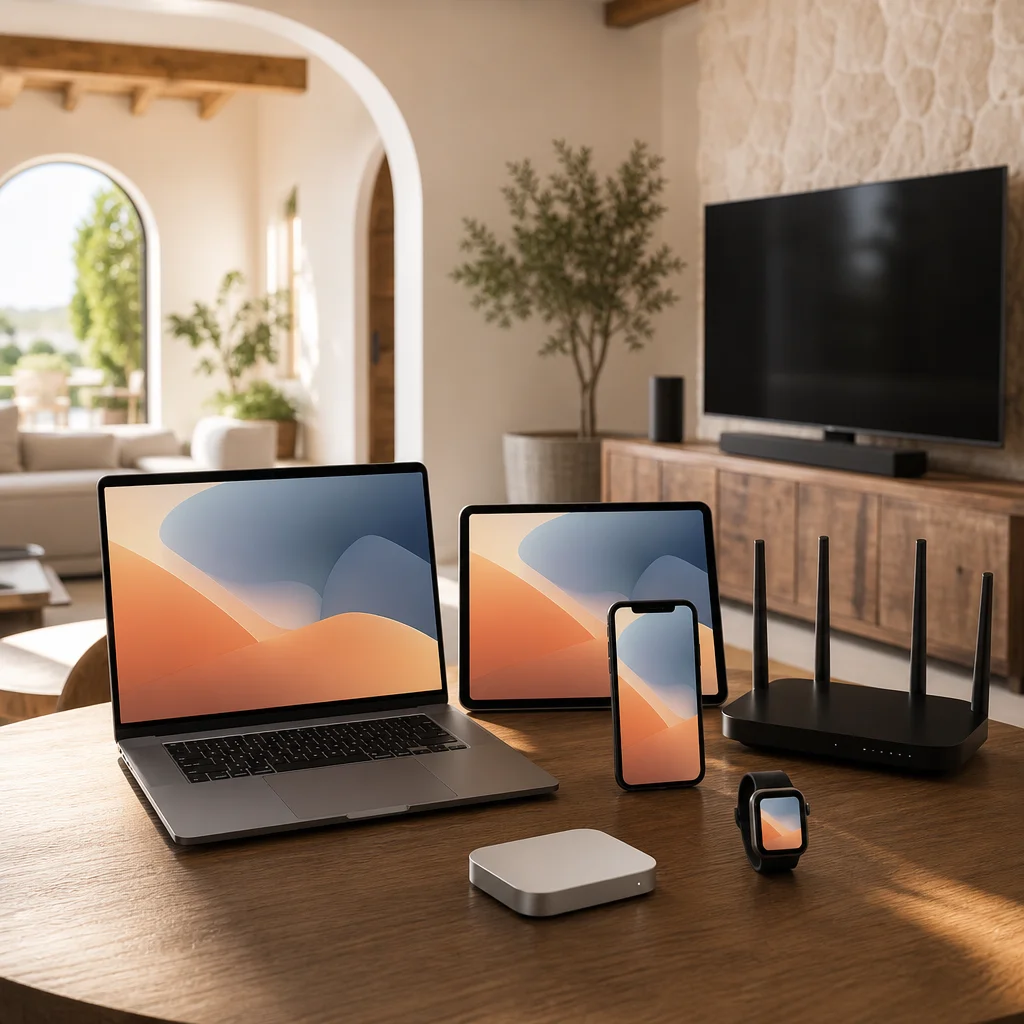
Not every device supports every feature. Before troubleshooting further, confirm your devices actually support Continuity, Handoff, and AirPlay.
Seamless device integration requires relatively recent hardware. Generally, iPhone 5s and later, iPad (4th generation) and later, and Mac models from 2012 onward support these features. However, specific features have specific requirements. Check Apple's official compatibility lists for your exact devices.
Software version matters enormously. Outdated operating systems can't communicate properly with newer devices. Go to Settings > General > Software Update on iOS, iPadOS, and watchOS. On Mac, go to System Settings > General > Software Update. Install any available updates and restart.
After updating, test your connectivity immediately. Updates frequently fix underlying communication bugs that cause these exact symptoms.
If one device is significantly older than others, it might not support the latest Continuity features. This isn't a malfunction, it's a hardware limitation. In these cases, you may need to replace the older device to achieve full ecosystem integration.
Act now: Check the software version on each device. If any device is more than two versions behind, update it before proceeding with further troubleshooting. Document which devices you're using and their compatibility status.
Resetting and Reconnecting Your Apple Devices
Sometimes the nuclear option is the right one. A complete device reset and reconnection clears corrupted connection states that standard troubleshooting can't fix.
Start with the least destructive approach: reset network settings. On iPhone or iPad, go to Settings > General > Transfer or Reset > Reset > Reset Network Settings. This erases your saved Wi-Fi networks and Bluetooth pairings, forcing your device to reconnect fresh.
Reconnect to your Wi-Fi network and re-pair your Bluetooth accessories. This typically takes just a few minutes and often resolves stubborn connectivity issues.
If network reset doesn't work, sign out of iCloud completely on the problematic device. Go to Settings > [Your Name] > Sign Out on iPhone/iPad or System Settings > [Your Name] > Sign Out on Mac. Choose to keep a copy of your data on the device to prevent losing information.
Wait two minutes, then sign back in using your Apple ID. Your device will re-authenticate and resync all your settings.
If issues persist, consider an Erase All Content and Settings (iPhone/iPad) or erase and reinstall macOS as a last resort. These are drastic measures, but they resolve connection issues that nothing else can fix. Back up your device first through iCloud or Finder.
Next step: Before erasing anything, try network settings reset first. Document which step resolved your issue so you can remember it if problems return.
Performance Optimization: Maximizing Continuity Across Your Ecosystem
Once everything's connected, optimize your setup for peak performance.
Keep Bluetooth on at all times. Continuity relies on Bluetooth to detect nearby devices. While Bluetooth does consume battery, the power draw is negligible compared to Wi-Fi or cellular. Turning Bluetooth off makes your devices invisible to each other.
Position your devices reasonably close together when initiating Handoff. While Continuity works at moderate distances, Handoff works best when devices are within 30 feet of each other. If you're attempting to hand off from your iPhone in the garage to your Mac upstairs, that's testing limits.
Keep your iCloud storage below 85% capacity. When iCloud fills up, sync processes slow dramatically or stop working. Check your iCloud storage in Settings > [Your Name] > iCloud > Manage Storage. If you're over 85%, clean up photos, videos, or documents, or upgrade your iCloud+ plan.
Enable background app refresh for apps that support Continuity. Go to Settings > General > Background App Refresh and ensure it's toggled on. This allows your apps to stay synchronized in the background.

Restart your devices weekly. This clears temporary memory caches and reconnects them fresh to your network. It's one of the most overlooked maintenance tasks.
Your action: Audit your iCloud storage right now. If it's critically full, clean up unnecessary items. Then enable background app refresh if it's currently disabled.
Advanced Troubleshooting for Persistent Connection Issues
If standard troubleshooting hasn't resolved your issue, try these advanced approaches.
Check for network interference. Cordless phones, microwaves, and baby monitors all operate on the 2.4GHz band and can degrade Wi-Fi performance. If you're using 2.4GHz Wi-Fi, move your router away from these devices or switch to 5GHz if your devices support it.
Disable VPN temporarily. Virtual private networks can interfere with device discovery and local network communication. If you use a VPN, disable it while testing Continuity and Handoff. If connectivity works without the VPN, your VPN settings need adjustment, or you need to contact your VPN provider about compatibility with local network features.
Reset your router completely. Unplug your router for 30 seconds, then plug it back in. Allow 2-3 minutes for it to fully restart and stabilize before testing.
Check your router's firewall settings. Some routers block certain ports or protocols that Continuity and AirPlay require. Access your router's admin panel and look for firewall settings. Consider temporarily disabling the firewall while testing to determine if it's the culprit. If it is, you'll need to adjust specific firewall rules rather than disabling it entirely.
Consider a manual IP configuration if your router's DHCP server is malfunctioning. Sometimes the router stops properly assigning IP addresses, causing intermittent connectivity. Restart your router's DHCP service through its admin panel.
Immediate action: If you haven't restarted your router in over a month, do it now. Most router issues resolve with a simple power cycle.
Preventing Future Problems: Best Practices for Seamless Integration
We've built our ecosystem to work seamlessly, and following a few best practices keeps it that way.
Keep all your devices updated. Set automatic updates to install overnight so you never fall behind. Go to Settings > General > Software Update > Automatic Updates on iPhone/iPad, and System Settings > General > Software Update on Mac.
Maintain a consistent network environment. Use the same Wi-Fi network for all devices and keep your router firmware current. Modern routers receive compatibility updates frequently.
Sign into the same iCloud account across all devices. This might seem obvious, but we still see users confused about why Continuity doesn't work when they're using different Apple IDs on different devices.
Keep your devices physically near each other occasionally. While you don't need to use Continuity constantly, occasional use keeps the connection protocols fresh and working smoothly.
Use our Personal Setup service if you're setting up a new device or have persistent issues you can't resolve. Our specialists can configure everything perfectly and answer any questions.
Monitor your network health. If you're experiencing other internet issues like slow downloads or frequent Wi-Fi drops, fix those first. Your internet connection quality directly impacts Continuity and AirPlay reliability.
Your final action: Schedule a weekly 30-second router restart on your calendar. This single habit prevents most connectivity issues before they start, keeping your entire ecosystem running at peak performance. We've engineered remarkable technology, and these simple maintenance practices ensure you experience it exactly as we designed it.
For further reading: Switching to Apple.