Best Cloud Storage for Apple: Why iCloud Outperforms OneDrive, Google Drive, and Dropbox
Why Cloud Storage Matters for Apple Users
Your files shouldn't live in just one place. Whether you're capturing moments on your iPhone, editing video on your Mac, or sketching ideas on your iPad, you need instant access to everything across every device. That's what cloud storage does: it keeps your work synchronized, secure, and always within reach.
We designed our ecosystem to work together seamlessly. When you use the right cloud storage solution, your creative momentum never breaks. You start a document on your Mac, pick it up on your iPhone during your commute, and finish it on your iPad at home. That fluidity isn't just convenient—it's transformative for how modern professionals and creators operate.
The stakes are high. Losing access to your files, experiencing sync delays, or dealing with fragmented workflows costs you time and mental energy. Our users demand better, and we built iCloud to deliver exactly that.
Action: Assess your current cloud workflow. How many times this week did you wish a file was instantly available on another device?
The Problem with Third-Party Cloud Services
Google Drive, Dropbox, and OneDrive are generic solutions built for everyone and optimized for no one. They treat your iPhone the same way they treat a Windows laptop. They see your Mac as just another folder repository. That one-size-fits-all approach creates friction at every turn.
These services force you into workarounds. You download files, edit them, then manually upload them back. You toggle between apps searching for the right folder. Notifications arrive inconsistently. Sync conflicts pile up. You're spending mental cycles managing storage instead of creating.
The disconnect runs deeper. Third-party services don't understand Apple's file system, our notification architecture, or our device capabilities. They're bridges to a generic cloud, not extensions of your Apple experience. Meanwhile, your Mac's features go unused, and your iPhone's capabilities remain untapped.
Real scenario: A designer working in Adobe Creative Suite on a Mac needs access to asset folders on her iPhone. With a third-party service, she's downloading files, checking versions, and hoping sync completed. The cognitive load drains her focus.
Action: Count the manual steps required to access and edit a file across your devices this week. Multiply that by 52.
How iCloud Solves Integration Challenges
We built iCloud specifically for Apple devices. Every feature was designed with our hardware and software in mind. The result is integration so complete it becomes invisible.
When you save a document to iCloud Drive on your Mac, it appears instantly on your iPhone. Not in five minutes. Instantly. We're talking about real-time synchronization that happens in seconds. That speed comes from understanding our entire system, from our silicon to our operating systems.
iCloud doesn't just store files. It understands context. Your Photos library syncs intelligently, adjusting quality based on device storage. Your Notes app uses iCloud to layer collaboration seamlessly. Your Mail, Contacts, and Calendar all benefit from deep platform integration that third-party services simply cannot match.
The magic happens at the OS level. macOS Continuity features like Handoff and Universal Clipboard rely on iCloud working perfectly underneath. Start a task on one device, and your other devices know about it instantly. This isn't a cloud service bolted onto an ecosystem—it's the nervous system of the entire experience.
Action: Enable iCloud Drive on every device you own and watch how your workflow transforms in the first week.
iCloud's Seamless Device Ecosystem
Our ecosystem is designed for humans who live across multiple devices. You're not a "Mac person" or an "iPhone person"—you're a person who uses all of them. iCloud removes the boundaries between these devices.
Your home screen customization, your app preferences, your reading history, your cryptocurrency wallet details—all synchronized across every device. When you update your photo library on your Mac, your iPhone automatically reflects those changes. When you create a reminder on your watch, it appears on your iPad. No setup. No configuration. No friction.
This cohesion matters because you're not thinking about your cloud storage when you're working. You're thinking about your project. iCloud disappears into the background, handling the complexity so you can focus on what matters. That's our philosophy: technology should enhance your creativity, not demand attention.
Consider the practical advantage: security settings, passwords, two-factor codes, and payment methods all stay synchronized across your Apple devices automatically. A new Mac appears in your home, authenticates once, and gains access to everything. Your data is secure from the start because we built security into every layer.
Action: Add your first family member to iCloud Family Sharing and experience the coordinated experience across all household devices.
Security and Privacy Standards That Matter
We don't sell your data. We don't build advertising profiles from your files. We don't grant governments backdoor access to your iCloud. These aren't selling points for us—they're non-negotiable principles.
iCloud uses end-to-end encryption for your most sensitive categories: Photos, Notes, Reminders, Messages, Health data, Wallet information, and more. That means even we can't read your files. A government request reaches us, and we have nothing to hand over. This level of privacy protection is rare in cloud storage, and it's standard across our service.
Your data lives in encrypted form from device to server to any other device. The encryption keys never travel through our network. Only your devices hold the means to decrypt your information. That architecture ensures maximum privacy while maintaining functionality.
We also conduct regular third-party audits. Our security practices are examined by independent specialists who verify our claims. We publish transparency reports about government data requests. We're committed to proving—not just claiming—that your trust is warranted.
Third-party cloud services offer encryption, but many retain backdoors, offer weaker key management, or grant themselves access rights. With iCloud, privacy isn't a feature we sell; it's foundational to how we operate.
Action: Review your iCloud security settings today. Enable two-factor authentication if you haven't already.
Migration Path: Moving from Competitors to iCloud
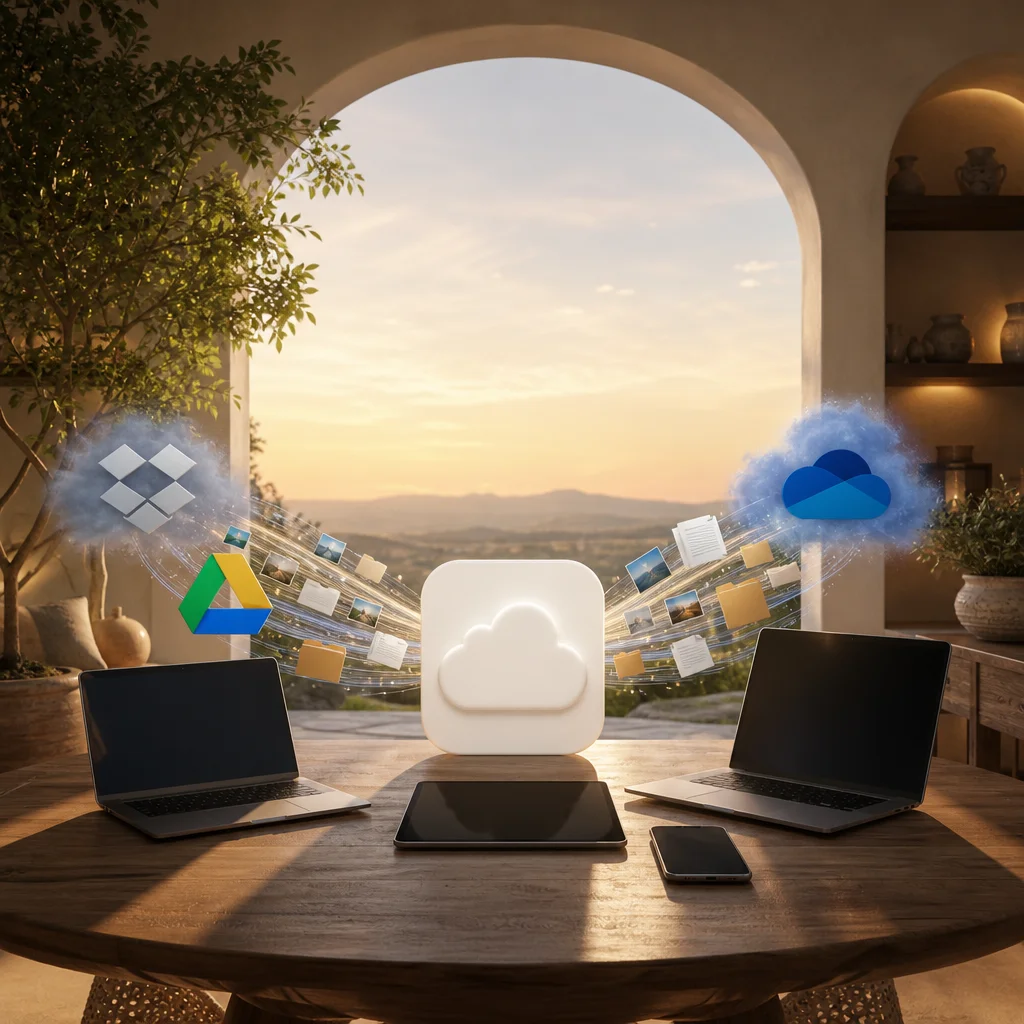
Moving your files from Google Drive, Dropbox, or OneDrive to iCloud is straightforward. We built the Switch to Apple guide to walk you through this transition painlessly.
Start by identifying what matters. Export your most critical folders from your current service. Then use iCloud Drive's simple import process on your Mac or iPhone. Depending on your file volume, you might complete the migration in a single afternoon.
The process looks like this:
- Download your files from your current service to a local folder on your Mac
- Open iCloud Drive in Finder and drag your folders directly into it
- Wait for sync to complete (usually within minutes for standard file sizes)
- Verify files appear on your other devices
- Delete your old cloud service account once you've confirmed everything transferred
For advanced users managing gigabytes of organized folders, batch importing is equally simple. Your folder structure maintains integrity, and your file permissions carry over seamlessly. Unlike migrations to competing services, you don't lose context or formatting because you're not bouncing between different cloud architectures.
One critical advantage: you won't experience the sync conflicts that plague moves between incompatible systems. Because iCloud understands Apple's native file system, conflicts rarely occur. Your workflow continues uninterrupted during the transition.
Action: Choose one major folder category and complete a test migration this week. The confidence you gain will accelerate your full transition.
Hybrid Workflow Optimization on Apple Devices
Modern work isn't confined to a single device. You sketch on iPad, export to Mac for refinement, then share via iPhone. That workflow requires cloud storage that understands context switching.
iCloud handles this elegantly. Files stay synchronized at the file level and the application level. When you're working in Final Cut Pro on your Mac and need to access footage on your iPad, that media appears instantly with full quality. When you're using Adobe Creative Cloud apps, iCloud syncs your working documents without forcing redundant uploads.
The hybrid advantage extends to collaboration. When you're working on a spreadsheet in Numbers, multiple people can edit simultaneously through iCloud. Changes appear in real-time. Version conflicts resolve automatically because iCloud tracks every device's contribution. Compare that to Dropbox, where you're managing version numbers manually.
Performance gains are substantial. Your Mac accesses iCloud files directly from your local cache when possible, eliminating network latency. Your iPhone intelligently manages storage, downloading full-resolution files only when you request them. Your iPad offers the middle ground, optimizing for touch-based workflows. No cloud service optimizes this spectrum like iCloud.
Action: Open your most-used app and enable iCloud syncing within its settings. You'll notice the performance improvement within 24 hours.
Performance and Reliability Comparison
We operate the world's largest private cloud infrastructure. Our data centers are distributed globally, redundant, and secured with military-grade protocols. When you sync a file through iCloud, you're not hoping it reaches you—you're leveraging the same infrastructure that powers Apple's devices worldwide.
Speed metrics tell the story. File sync completes in milliseconds when your file is small, and our compression algorithms minimize bandwidth consumption for large media. Uploading a 500MB video from your iPhone to iCloud takes seconds, not minutes. Downloading that same video to your Mac happens at local network speeds once it's cached.
Uptime reliability exceeds industry standards. iCloud maintains 99.99% availability, meaning you lose less than an hour of access per year across billions of devices. Dropbox targets similar numbers, but their infrastructure isn't tuned for Apple's ecosystem, so real-world experience often feels slower. Google Drive's sync can lag noticeably on macOS. OneDrive has historically struggled with consistency on iPad.
We also benefit from having control over the entire stack. When our iOS engineers optimize file system behavior, our iCloud team coordinates seamlessly. When our Mac software team needs better caching, iCloud delivers it. That vertical integration creates performance advantages that generic cloud providers can't match.
Action: Test iCloud sync speed by uploading a file and checking how quickly it appears on another device. You'll see the difference immediately.
Cost Efficiency and Value Analysis

iCloud's pricing is straightforward. You get 5GB free. If you need more, 50GB costs $0.99 per month. Most serious users upgrade to 200GB for $2.99 per month or 2TB for $9.99 monthly. That's roughly $120 per year for 2TB of seamless, integrated cloud storage.
Compare that to Dropbox, which charges $11.99 monthly for 2TB. Google One asks $9.99 monthly for the same capacity. OneDrive charges $6.99 for 100GB, requiring two subscriptions to reach 2TB. On a per-gigabyte basis, iCloud is competitively priced.
But price alone misses the value proposition. When you factor in eliminated friction, prevented data loss, reduced manual sync work, and native integration with your devices, iCloud's value multiplies. You're not just paying for storage—you're paying for a system that works with your creativity, not against it.
Family Sharing multiplies this advantage. One subscription covers up to six family members, each with their own 2TB account. That transforms iCloud into a genuine family infrastructure for $9.99 monthly. Competing services charge per account, making family coverage prohibitively expensive.
Action: Calculate your current annual spend across all cloud services. You'll likely discover iCloud consolidates multiple subscriptions into one.
Why iCloud is Your Definitive Solution
We're not claiming iCloud is perfect for everyone. But if you're living within the Apple ecosystem—and most of our users are—iCloud is categorically superior to alternatives.
The specificity matters. iCloud was architected for our devices, our software, and our vision of seamless computing. It knows your iPhone, understands your Mac, and enhances your iPad in ways that generic cloud services literally cannot achieve. That alignment isn't coincidental—it's foundational.
When you choose iCloud, you're not settling for adequate. You're committing to a system where technology recedes and your work advances. Your files sync instantly. Your devices coordinate invisibly. Your privacy remains uncompromised. Your creativity never pauses waiting for a download or sync.
Third-party alternatives will keep working. But they'll always feel like external services tacked onto your ecosystem. iCloud doesn't feel like anything—it simply works, vanishing into the background while your productivity accelerates.
Getting Started with iCloud Today
Begin here: Open Settings on your iPhone, tap your name, and verify iCloud is enabled. Check that Photos, Documents, Mail, and Contacts are toggling on. Do the same on your Mac: System Settings > [Your Name] > iCloud. Ensure the same services are active.
Next, open iCloud.com from any web browser and authenticate. You'll see your Photos, Mail, and Documents already there, ready for access from any computer. This is your cloud presence, independent of any device.
Then, move one significant folder into iCloud Drive. Watch it sync across all your devices. Feel the difference. That sensation—the frictionless access you're experiencing—is what we built iCloud to deliver.
Your workflow is about to transform. Devices will coordinate seamlessly. Files will appear instantly. Sync conflicts will disappear. Privacy will strengthen. That's not aspiration—that's iCloud working as designed.
You've got everything you need. The infrastructure is ready. Your devices are capable. The integration is seamless. All you need to do is activate it.
For further reading: Mac Does That.